 Los Angeles, CA — As applications for Fall 2026 head into final stages, prospective students across the globe are looking closely at one of the world’s most competitive public universities: the University of California, Los Angeles (UCLA). Known for its powerful academics, vibrant student life, and global reputation, UCLA continues to attract some of the brightest minds from California, the United States, and beyond. This 2026 admission guide breaks down what applicants need to know about acceptance rates, tuition, financial aid and scholarship opportunities — giving families and students a clear, realistic picture of UCLA’s expectations and offerings.
A Highly Selective Admission Landscape
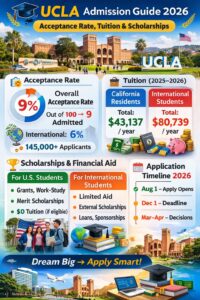
Gaining a place at UCLA is more competitive now than ever before. According to recent institutional data, UCLA’s acceptance rate for undergraduate freshmen has hovered in the single-digit range. Reports estimate the overall admit rate to be around 9–11% for recent cycles, showing just how selective the process is for applicants worldwide.
This selectivity is not accidental. UCLA receives well over 100,000 applications annually from highly qualified students. Applicants are evaluated based on academic excellence, extracurricular achievements, personal character, and the strength of their application essays and recommendations. Though exact figures for the Fall 2026 cycle are still being finalized, trends suggest this year will continue to reflect UCLA’s commitment to attracting a diverse and academically outstanding incoming class.
In quantitative terms, accepted students often present near-perfect academic records, with average high school GPAs consistently near the top of their class. For many applicants, strong academic achievement remains essential, but holistic elements like leadership, community service, and personal storytelling can set applications apart.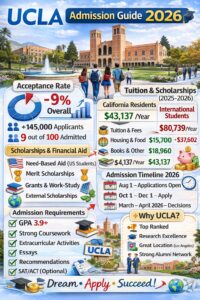
Breaking Down the Cost: Tuition, Fees & Living Expenses
For many families, cost remains a top concern. Fortunately, understanding UCLA’s tuition and overall cost of attendance enables clearer financial planning.
Undergraduate Tuition
For the academic year 2025-26, the estimated cost — which sets a useful benchmark for planning — is as follows:
- California (in-state) residents: ~ $15,700 for tuition and campus fees
- Non-California (out-of-state) residents: In addition to campus fees, non-residents pay a supplemental tuition, bringing the total closer to ~$80,700 annually.
These figures cover tuition, campus fees, housing, meals, books, transportation, personal expenses, and health insurance. It’s important to remember that actual expenses can vary based on choices like housing type, meal plans, transportation needs, and personal spending.
Despite what might initially seem like high costs, especially for out-of-state students, UCLA’s overall reputation as one of the most cost-efficient universities in the US persists. Affordability rankings from national publications continue to list UCLA among the best value institutions, thanks largely to its strong financial aid ecosystem.
Financial Aid & Scholarships: Making UCLA Affordable
One of UCLA’s distinguishing strengths is its extensive financial aid structure. The university is committed to ensuring that qualified students are not barred by financial limitations.
Types of Aid Available
UCLA’s Financial Aid & Scholarships Office works with families to assemble aid packages that may include:
- Grants and Scholarships: These require no repayment and can be merit- or need-based.
- Work-Study Programs: Part-time employment opportunities help students cover living expenses.
- Loans: Federal and private options are available for students who choose to borrow.
To access federal aid and many state programs, U.S. citizens and eligible non-citizens must complete the Free Application for Federal Student Aid (FAFSA). Eligible undocumented students in California use the California Dream Act Application (CADAA). Both applications are available early in the cycle, with a priority deadline commonly in early March of the year students plan to enroll.
Scholarship Highlights
UCLA offers a wide spectrum of scholarships catering to different student strengths and backgrounds:
- Merit-based Awards: Recognize exceptional academic performance and leadership.
- Need-based Grants: Allocated based on financial need, helping bridge the gap between cost and ability to pay.
- Specialized Awards & Departmental Scholarships: Awarded by colleges, departments, and external partners, these may honor talent in STEM fields, arts, humanities, and more.
Notably, the Blue & Gold Opportunity Plan guarantees that eligible California residents with family incomes below a certain threshold (commonly under $80,000) will have their tuition and systemwide fees fully covered. This initiative has made UCLA financially accessible for thousands of families who might otherwise find costs prohibitive.
Financial Reality: What Do Families Actually Pay?
The headline figures for full cost are not always the best representation of what families actually pay. After accounting for financial aid, scholarship awards, and grants, many students pay significantly less than the sticker price.
For example:
- Nearly half of undergraduates graduate debt-free, a statistic that underscores both generous aid packages and prudent cost planning by students.
- Federal Pell Grants, state awards, and institutional scholarships frequently reduce the net cost for lower-income students to a fraction of published tuition.
In this context, UCLA transforms from an expensive public university into a highly achievable educational investment for students with strong academic records and proactive financial planning.
Beyond Numbers: Why UCLA Matters
While acceptance rates and tuition figures are vital, they represent just part of the story. UCLA’s broad array of academic programs, world-class faculty, and research opportunities ensure that students receive not just a degree, but a transformative educational experience.
With strengths spanning arts, sciences, engineering, business, and health sciences, UCLA prepares students for a range of impactful careers. Whether pursuing research breakthroughs, community service, or leadership roles in global industries, graduates of UCLA often cite their undergraduate years as foundational for lifelong success.
The university’s vibrant campus life, cutting-edge facilities, and location in the heart of Los Angeles further enrich the student experience, creating connections and opportunities that extend far beyond graduation.
Aspiring Bruins aiming for Fall 2026 should approach the application with confidence, preparation, and a strategic plan — both academically and financially. Understand the competitive nature of admissions, but also recognize the support systems in place that make UCLA a reachable goal for many students.
Start early with your applications, stay proactive with financial aid and scholarships, and don’t hesitate to use resources provided by UCLA’s admissions and financial aid offices. With the right preparation and effort, UCLA remains not just a dream, but a tangible destination for ambitious scholars ready to make their mark.